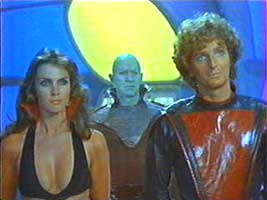
Sadly only to die in lightsabre combat with a robot.
Tuesday, 15 February 2011
Marjoe (1972)
Marjoe is one man's confession for a misspent childhood and a dishonest career as a young adult. Marjoe Gortner was a child preacher, forced into the pulpit by his parents and taught to learn sermons by rote and recite them to his congregations. After raising (by his estimate) $3,000,000, he managed to escape from this life and lived with an older woman for a time. Eventually he did return to preach, citing monetary problems. However, after a few years he suffered a crisis of conscience, and decided to pay penance to society by inviting a film crew to follow him while preaching and exposing the hucksterism and sheer cynicism of these travelling preachers, who simply fleece believers of their money. Marjoe himself is a charming presenter, speaking very frankly and openly about his experiences, both confessing that tricks are used to exploit the vulnerability, and openly lamenting that he has done wrong in his life by preaching what he doesn't believe to the masses. The vast majority of the scenes are of Marjoe's preaching, which I have to say I found very disturbing. He speaks nigh-verbatim from a script to each different meeting, and the people are held in utter thrall by his various platitudes. People moan and shake and collapse onto the floor when "healed," and pay through the nose for the pleasure of this intense and socially-pressured placebo effect. Perhaps the most harrowing moments are the shots of bewildered children who show real fear as the adults around them spasm and warble in "tongues". Mr. Gortner deserves great praise for his courage in sabotaging a career path which would have gained him easy money, just to reveal to the wider world the essential dishonesty of this kind of preaching.

Sadly only to die in lightsabre combat with a robot.
Labels:
1972,
HOWARD SMITH,
MARJOE,
MARJOE GORTNER,
SARAH KERNOCHAN
Sunday, 13 February 2011
Gamera: Daikaijū Kuchu Kessen / Gamera: Guardian of the Universe (1995)
After many years of Gamera films aimed at children, not to mention an incredibly lazy stock-footage film made by the company who bought Gamera owners Daiei from bankruptcy, the franchise was in need of a reboot. And what a reboot it was, dispensing with the more childish elements of the series and creating a darker and more adult action story. Of course, the ridiculous Gamera-gore is present, but in this environment it seems more appropriate. As kaiju films go, this movie is remarkably well-paced, keeping up enough monstery action to offset the human drama. Gamera is pitted once again against his earliest foe, Gyaos, though with the updated back-story that he is a biological defence mechanism created by the lost civilisation of Atlantis. The Gyaos initially appear on a rain-soaked tropical island, and given that Jurassic Park came out just two years prior, the inspiration is plain to see. They even find time for the plucky female scientist to go rooting through an enormous pile of Gyaos guano. The Gyaos themselves suffer from the same problem as any flying monster, as they tend to look stiff and unnatural, but the final Super Gyaos looks much better, attacking from both sky and ground by using its wings to walk. And both Gamera and Gyaos look colossal, once again due to steller miniature work and clever use of forced perspective and low camera angles. It's not perfect, as the scene transitions look incredibly amateur, and the dubbing, while not the worst I've heard, can be a little bit hokey. But overall this is a very good film, and happily it's only the first in a trilogy of Heisei Gamera films, each of which is said to be better than the last, even though only two out of three feature Steven Seagal's daughter.

Imagine how much better Disney's Atlantis could have been...

Imagine how much better Disney's Atlantis could have been...
Labels:
1995,
AYAKO FUJITANI,
GAMERA: DAIKAIJU KUCHU KESSEN,
GAMERA: GUARDIAN OF THE UNIVERSE,
SHINOBU NAKAYAMA,
SHUSUKE KANEKO
True Grit (2010)
Jeff Bridges is always an awesome actor, even when he talks like a dog barking, and his portrayal of Rooster Cogburn, the role made famous by Western legend John Wayne is no exception. He's the quintessential grizzled old gun-slinger, and spends the entirety of this film swinging between the poles of "cool as a cucumber" and "laugh-out-loud hilarious", throwing gruff insults at Matt Damon and being blunt to the point of amusement. But there is someone in this film who threatens to steal every last scene from Bridges; young Hailee Steinfeld, who after a series of supporting roles in teen film and TV landed her first major role as Hattie Ross, and has already landed a well-deserved Oscar nomination, all at the tender age of 14. And unlike many Academy choices, this pick could not be more deserved. Indeed, I'll be shocked if she doesn't win, despite the other big names in that category. Steinfeld has to be one to watch, as in every single scene she has a maturity far beyond her years and delivers barbed comments with pinpoint accuracy, reducing most of the adults she meets to quivering piles of insecurity. Her litigious nature can be trying at times, but generally she is completely at ease, despite sharing scenes with a legend like Bridges, and a Hollywood A-lister like Matt Damon. Finally the helmsmen, the Coen Brothers, show once again that they can perfectly balance action, story and comedy within a genre that is generally not know for being funny. But True Grit is cuttingly funny, mostly thanks to stinging comments thrown back and forth between the protagonists. Westerns of old can seem formulaic and stale, but this film breathes new life into the genre and shows the feasibility of making this aged type entertaining still, even without adding extraterrestrials, as with this year's upcoming Cowboys & Aliens.

"The eyepatch is to give y'all a fightin' chance."

"The eyepatch is to give y'all a fightin' chance."
Labels:
2010,
ETHAN COEN,
HAILEE STEINFELD,
JEFF BRIDGES,
JOEL COEN,
TRUE GRIT
Friday, 11 February 2011
Batman (1989)
It's standard practice to judge that franchises only get worse with the addition of more sequels/reimaginings/reboots, but the Batman franchise violently rebuked this in 2005 with Christopher Nolan's Batman Begins, and even moreso with its 2008 sequel The Dark Knight. Finally, Tim Burton's 1989 take on the Batman mythos had a challenger. But while the scale of Nolan's Batman films is much grander, Burton's film has a strange blend of comic book style and realism that feels very natural for a Batman story. And of course, The Dark Knight sparked a debate about who was the best Joker - Jack Nicholson's chuckling gang boss or Heath Ledger's anarchist psychotic. Sadly these days, the campy glory of Cesar Romero is discounted. These two Jokers are clearly very different, and it would be very difficult to transpose either one to the other film and have it feel appropriate. Nicholson's Joker is a mobster with a sense of humour, acting much more like the public perception of the Joker as the Clown Prince of Crime, and generally being incredibly funny while being extremely sinister. However, while he is clearly insane, he retains a calculating intelligence and a swaggering confidence, though sometimes he does seem less like the Joker, and more like Jack Nicholson. Ledger's Joker is quite a different kind of animal - he is utterly terrifying in his seemingly random and horrendous acts of violence. This is not to say that Ledger's Joker isn't funny, it's just that it's a nervous laughter, the kind you offer to a gregarious lunatic with a hunting knife in his hand. This Joker is smart too, but he seems to be making things up as he goes along (although many of his morality play gambits take a slightly unrealistic amount of forward-planning). Nicholson has certainly lost his place as the undisputed King of Jokers, but arguments can be made both ways on this issue. Conversely, I would argue that Michael Keaton outshines Christian Bale as Bruce Wayne and Batman, not by much, but Keaton's portrayal is far more subtle, and (as Batman) even more intimidating than Bale, even with the gravel-gargling Bale Batman-voice. This is still a very entertaining film, and will always shine out as both one of the best Batman films, and one of the best superhero films.

Let's overlook Batman's incredible body count in the film.
Labels:
1989,
BATMAN,
JACK NICHOLSON,
MICHAEL KEATON,
TIM BURTON
Wednesday, 9 February 2011
V For Vendetta (2006)
In 1984's Nineteen Eighty-Four, John Hurt played the role of everyman Winston Smith. Through his unwise action of thinking outside the boundaries enforced by the Party, Winston is subjected to hideous torture until his will is bent to the liking of the overlord of Airstrip One, Big Brother. Just over 20 years later, the roles have been utterly reversed - John Hurt is now British Chancellor Adam Sutler (Susan in the original comic book), who rules this green and pleasant land with an iron fist and a powerful will. He even resembles Big Brother, with his moustachioed face appearing massive on the giant viewscreen in his government Lair O' Doom. This time the heroes are Hugo Weaving's V, a remarkably eloquent and frighteningly deadly masked freedom terrorist, and Natalie Portman's Evey Hammond, a normal girl caught up on V's attempt to take down the corrupt Norsefire party. Now, fans of the original comic book (creator Alan Moore included) will likely despise this adaptation, as nearly all talk of anarchism is expunged and instead V is fighting to free people from an oppressive government, not from government in general. In fact, the greatest, and generally quite fair, criticism is that this is merely a shallow ersatz of the Bush Administration, satirising the increased intrusion into public freedom post-9/11, rather than the anti-Thatcherite tone of the original story. This is generally fair, but since when was satire either boring or wrong? A faithful adaptation this is not, but this is still a clever and powerful film, treading some old ground and scouring some new as well. The entire story is held together well by its enigmatic and charismatic hero, and simply Hugo Weaving's vastly verbose and veritably victorious introductory monologue is well worth a watch. This film deserves little of the scorn it earns, as it remains entertaining, though not as inspirational as some dewy-eyed anarchists might wish.

There seems to be a theme developing with these totalitarian regimes...

There seems to be a theme developing with these totalitarian regimes...
Left Behind II: Tribulation Force (2002)
We're back for round two, another sojourn into eschatological entertainment. A week has passed since the Rapture and planet Earth is quickly succumbing to the evils of world peace and a single world currency. But fouler things are afoot, as the Daniel-Craigian, almost-Russian baddie Nicolae plans to have himself be declared the Messiah and thereby unite the world under the banner of a single humanist religion. But that's not important, since this film is more about evangelism than entertainment. In fact, almost every single characteristic of right-wing Christian ministry is present - Jews for Jesus (Rabbi Ben Judah finally accepts Jesus as the Messiah on behalf of his entire religion); the fatuous Good Person Test (in which one single act of lying or petty theft is enough to brand you as an unforgivable liar or thief for life); indeed the main characters seem to be one transparent metaphor for evangelical ministry. The titular Tribulation Force (a title far too grand for this tiny band) are basically missionaries; charged with spreading an impossible-sounding story to the world, and determined to do so, no matter how hopeless. Likely using their Good Person Test, which two out of four main characters would fail miserably, having spent the better part of the film lying through their teeth. That isn't to say that there aren't some good parts - a suicidal side-character gives the perfect answer to the G.P.T. - "Have you ever lied?" "Yes." "What does that make you?" "Human." But these are in a minority. Having run out of fundamentalist Christian cliches, the film even throws in a rom-com style "silly misunderstanding" that wastes around ten minutes. Even the rest of the film is a self-confessed waste, as the characters early state that biblical prophecy cannot be averted, and then spend ninety minutes trying to do so. Admittedly, this is an improvement on the original, much in the same way that chemotherapy is an improvement on cancer.

Despite pacifist and atheist leanings, this is what a Tribulation Force should be made up of!

Despite pacifist and atheist leanings, this is what a Tribulation Force should be made up of!
Friday, 4 February 2011
Gojira tai Biorante / Godzilla vs. Biollante (1989)
Why Godzilla vs. Biollante has never been released in the West outside of an out-of-print German release, I will never know. This is one of the best of the entire franchise, bringing some much-needed fresh ideas, some excellent monster battles, and one of the most original and impressive-looking monsters in kaiju history. Biollante herself is a genetic abomination, the result of the blending of human, rose and Godzilla D.N.A., and the result is an enormous mass of writhing vines, topped with a tusked crocodilian maw. But beyond the excellent and original appearance of the beast, there is a truly tragic story; she is the result of a father's inability to handle the death of his only daughter, and his attempt to keep her spirit alive in some form or another. This is typical of the mad scientist trope, but Dr. Shiragami is probably the most sympathetic example I have seem. But this film is not good simply based on the single central tragedy, as the humans have some great success in repelling Godzilla on their own. Ordinarily another giant monster or some kind of gigantic robot is required to ward off the atomic beast, but this time the humans are more sly. The Super X super-plane is back again, in Mk. II form, this time equipped with a Fire Mirror, designed to reflect Godzilla's beam attack back at himself, attempting to use his own might against him. When this fails, Anti-Nuclear-Energy Bacteria designed for clearing up nuclear accidents are brought in in an attempt to deplete Godzilla's available energy, with some degree of success. Finally, this film introduces us to Miki Saegusa, long-time supporting character and resident elf-eared psychic in the Heisei period of Godzilla films. As monster films go, this is noticeably less slow than some of its competitors, and both entertaining and engaging. A good balance of characters, action and special effects.

And Captain Gondo nearly manages to challenge the manliness of Captain Gordon.

And Captain Gondo nearly manages to challenge the manliness of Captain Gordon.
Labels:
1989,
GODZILLA VS. BIOLLANTE,
GOJIRA TAI BIORANTE,
KAZUKI OMORI,
KUNIHIKO MITAMURA,
YOSHIKO TANAKA
Subscribe to:
Posts (Atom)